

Save Our Homes Florida lets you keep your tax savings when you move to a new primary residence in the state. You don’t lose the assessment cap benefits you built up over years at your old home. Instead, you can transfer those savings through Florida homestead portability and cut your property tax bill at your next house. Most homeowners don’t know this option exists. They relocate and lose hundreds of thousands in accumulated benefits because they miss the transfer deadline or skip the application process. teste
This guide shows you precisely how to preserve your property tax savings when buying your next Florida home. You’ll learn who qualifies for portability, how to calculate your portable assessment benefit, and the specific steps to file your DR-501T form. We cover common mistakes that cost homeowners thousands and how to avoid them. You’ll also get clear deadlines and document requirements so you don’t miss your window to transfer save our homes benefits.
Save our homes florida portability isn’t complicated once you understand the rules. You just need to know what to do and when to do it. Let’s walk through everything you need to protect your save our homes florida benefits when you move.
What Is Save Our Homes Florida Portability?

Save Our Homes portability lets you transfer your tax savings when you move. You don’t lose the benefit you built up at your old home. Instead, you carry it to your new property.
This differs from the standard 3% assessment cap. That cap limits how much your assessed value can grow each year. Portability takes the total savings you built and moves them with you.
How the Assessment Cap Transfer Works
According to the Florida Department of Revenue, you calculate the difference between market value and assessed value at your old home. That difference becomes your portable benefit.
You then subtract this benefit from your new home’s market value. This gives you a lower assessed value and smaller tax bill.
Maximum Portability Amounts and Limits
Florida law caps the portable benefit at $500,000. You can transfer up to this amount when you move.
The St. Johns County Property Appraiser notes you must apply within two years of leaving your old home. Miss this window, and you lose the benefit.
Real-World Savings Example
Here’s how it works in practice. Your old home has a $300,000 market value but only $150,000 assessed value. That’s $150,000 in accumulated savings.
You buy a new home worth $450,000. You subtract your $150,000 benefit from the market value. Your new assessed value starts at $300,000 instead of $450,000.
Without portability, you’d pay taxes on the full $450,000. With it, you save thousands each year.
Who Qualifies for Save Our Homes Florida Portability?
Not every homeowner can transfer save our homes benefits when moving. You must meet specific requirements to use Florida homestead portability.
Primary Residence Requirements
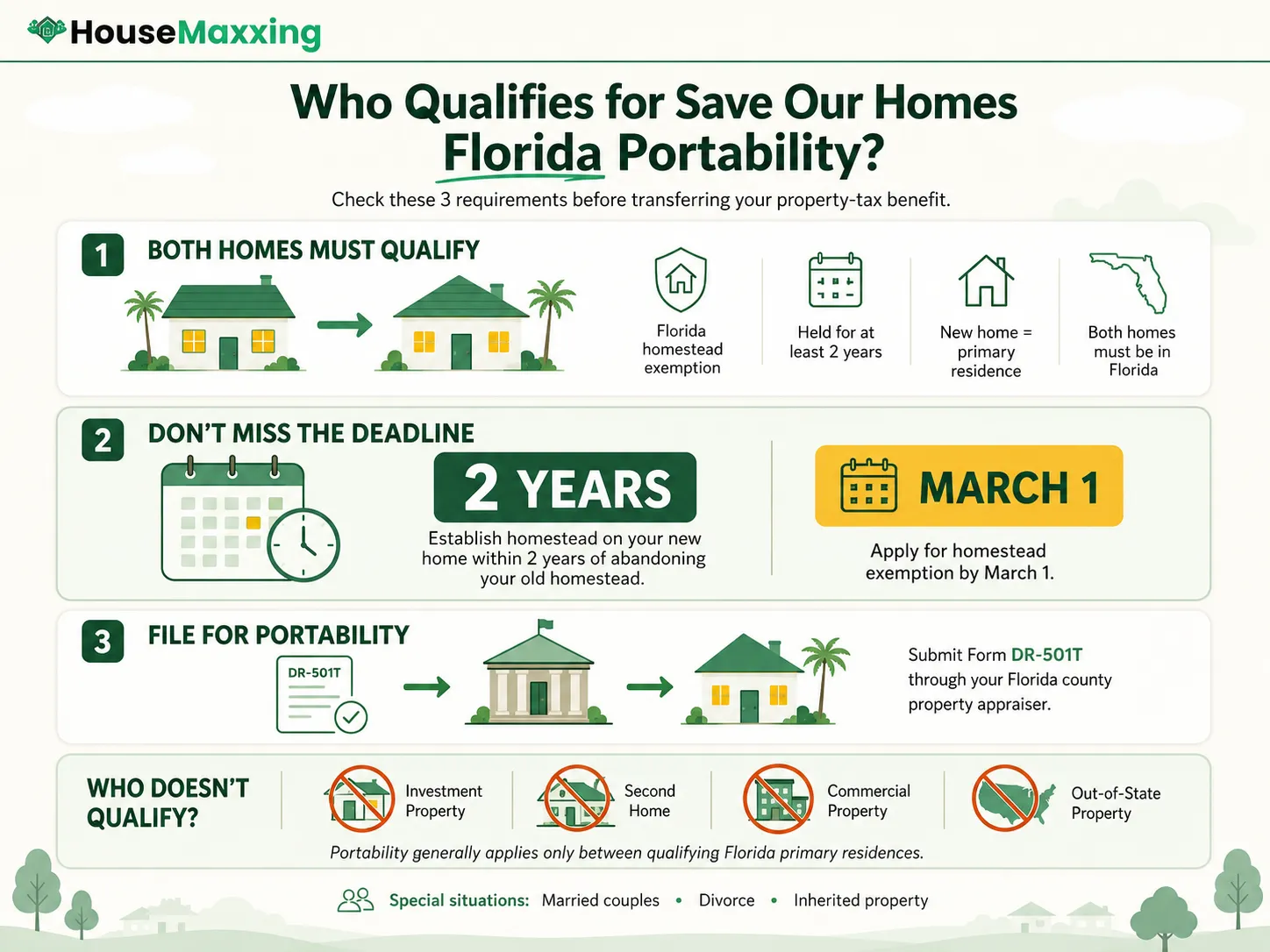
You need a homestead exemption on your current home for at least two years. The new property must become your primary residence. Both homes must be in Florida.
According to the Lee County Property Appraiser, you cannot transfer benefits from out-of-state properties. Your new home must also qualify for homestead exemption. You’ll file the DR-501T form in Florida with your county property appraiser.
Timing Rules You Must Follow
You have a two-year window to establish homestead on your new property. This starts when you abandon your old homestead. Miss this deadline, and you lose your portability rights.
The Pinellas County Property Appraiser provides tools to calculate your portable assessment benefits. Apply for homestead exemption on your new home by March 1st. This protects your Florida property tax portability for the current year.
When Portability Doesn’t Apply
Investment properties don’t qualify for Save Our Homes portability. Second homes and commercial properties are also excluded. You can only transfer benefits between primary residences.
Special rules apply for married couples and divorces. Inherited properties may have different requirements. House Maxxing helps homeowners understand these rules and file successful property tax appeals when assessments seem too high.
How to Calculate Your Save Our Homes Florida Portable Benefit
Understanding how to calculate your portable assessment benefit helps you plan your next move. The formula is simple. You subtract your current home’s assessed value from its just value. The difference is your portable benefit.
The Portability Formula Explained
You can find both values on your property appraiser’s website. Just value represents market value. Assessed value is what you pay taxes on. For example, if your just value is $400,000 and your assessed value is $320,000, your portable benefit is $80,000.
According to the Sarasota County Property Appraiser, this benefit transfers when you move. House Maxxing can help you verify these calculations and file your portability application correctly.
Calculating for Homes of Different Values
The calculation changes based on your new home’s price. If you move to a more expensive home, you transfer the full benefit. Your new assessed value becomes the just value minus your portable benefit.
Moving to a less expensive home requires a proportional calculation. You multiply your benefit by the ratio of new home value to old home value. This protects the benefit while keeping it fair.
Understanding Proportional Transfers
Here’s how proportional transfers work in practice. Say you have an $80,000 benefit and move from a $400,000 home to a $300,000 home. You multiply $80,000 by 0.75 (300,000 ÷ 400,000). Your new portable benefit is $60,000.
The Palm Beach County Property Appraiser provides step-by-step guidance for filing an application. You must file within two years of establishing your new homestead to claim Florida homestead portability benefits.
How to Apply for Save Our Homes Florida Portability Transfer
Transferring your Save Our Homes benefits to a new property takes planning. You need the right documents and must meet strict deadlines. Here’s how to complete the process.
Required Documents and Information
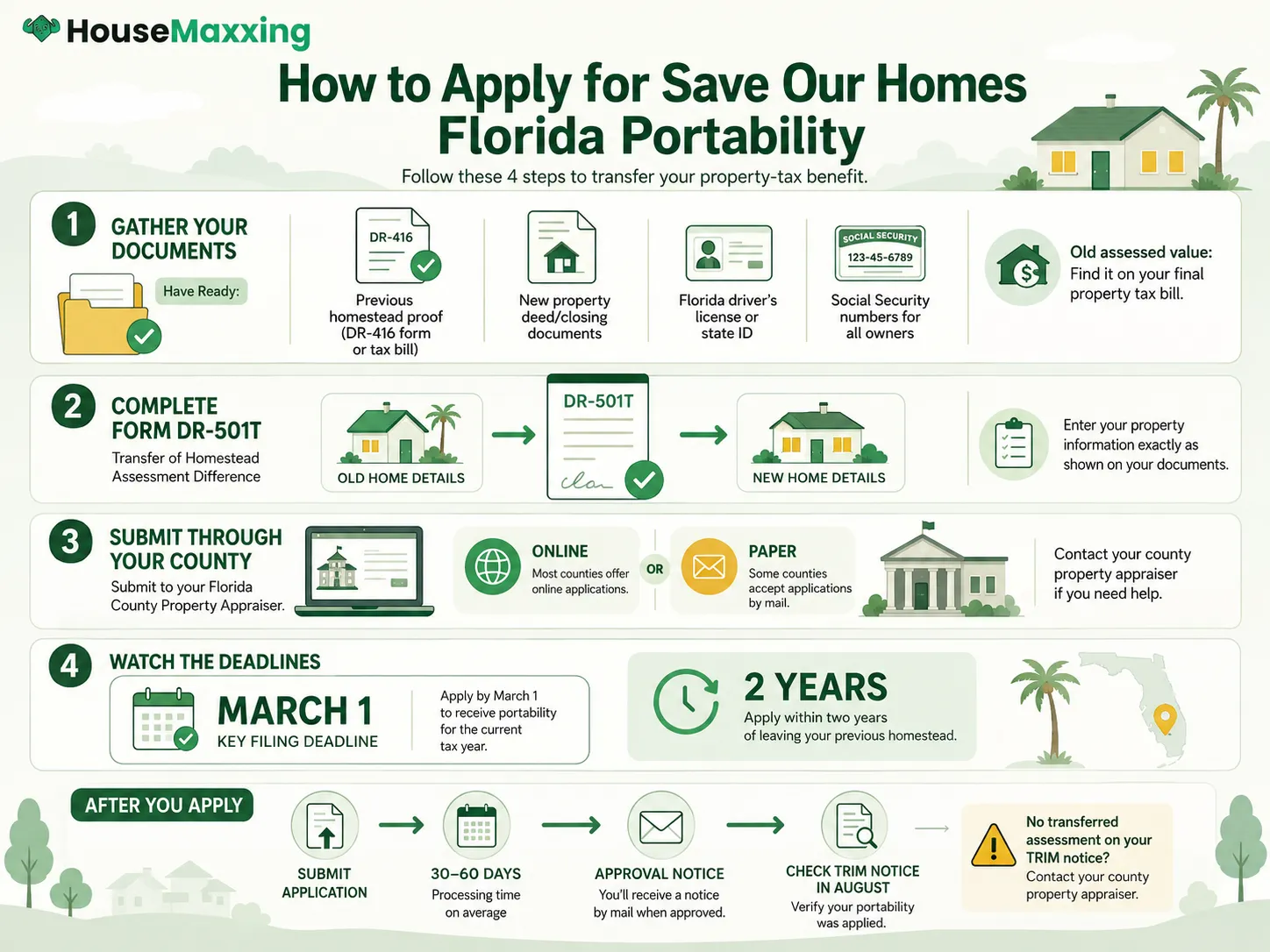
Gather these items before you start your application:
-
Proof of your previous homestead exemption (DR-416 form or tax bill)
-
Deed or closing documents for your new property
-
Valid Florida driver’s license or state ID
-
Social Security numbers for all owners
You’ll also need the assessed value from your old home. This appears on your final property tax bill. Keep copies of everything for your records.
Filing Through Your County Property Appraiser
Most Florida counties now offer online portability applications. Visit your county property appraiser’s website to access the portal. You’ll complete the DR-501T Transfer of Homestead Assessment Difference form.
The form asks for your old property address and new property details. According to the Florida Bar legal analysis, you must apply within two years of leaving your old homestead. Enter all information exactly as it appears on your documents.
Some counties accept paper applications by mail. Call your property appraiser’s office if you need help with the online system.
Application Deadlines and Processing Times
The March 1st deadline is critical for Florida homestead portability. Submit your application by this date to get portability for the current tax year. Miss it, and you’ll wait until next year.
Processing takes 30 to 60 days on average. You’ll get a notice by mail when your application is approved. Check your TRIM notice in August to verify your portability was applied. Contact your county office if you don’t see the assessment difference transferred.
Common Save Our Homes Florida Mistakes and How to Avoid Them
Homeowners often lose thousands in tax savings by making simple errors. Here’s how to protect your benefits.
Missing the Application Window
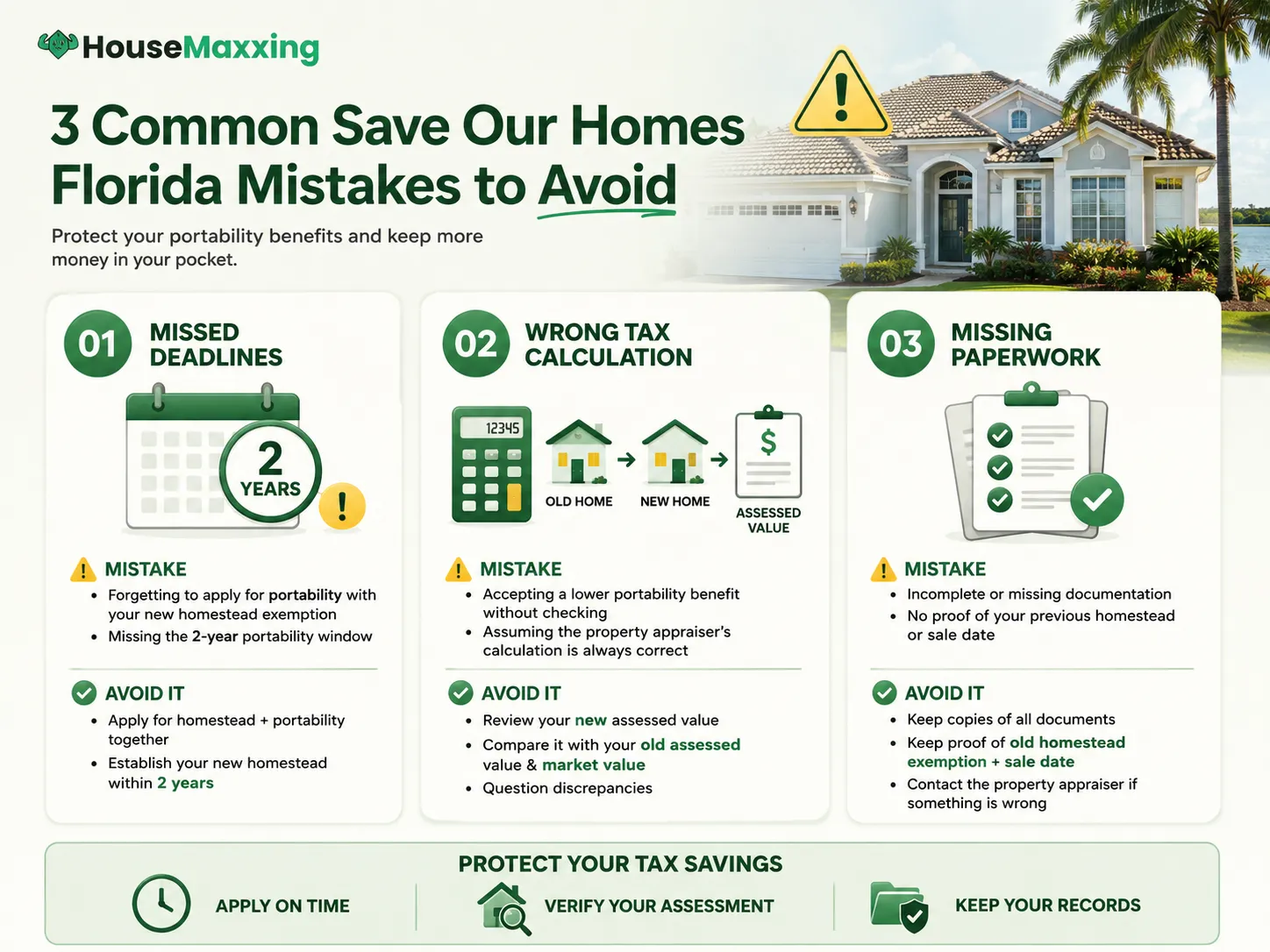
The most common mistake is not applying for portability when you file your homestead exemption. You must submit both at the same time on your new property.
Another timing error happens when you sell your old home and buy a new one more than two years apart. Florida requires you to complete both transactions within this window. Miss it, and you lose your accumulated Save Our Homes Florida benefits.
Incorrect Benefit Calculations
Many homeowners accept lower transferred benefits than they deserve. The property appraiser’s office sometimes makes calculation errors.
Always verify your new assessed value after portability is applied. Compare it against your old home’s assessed value and market value. If the numbers don’t match your expectations, ask questions.
Documentation Errors
Missing or incomplete paperwork kills many Florida homestead portability applications. You need proof of your old homestead exemption and sale date. Keep copies of everything.
If your application gets denied or calculated wrong, you can appeal. Contact your property appraiser’s office first. They often fix simple mistakes quickly. For complex issues, consider hiring a tax professional or seeking legal aid.
Conclusion
Transferring your Save Our Homes Florida benefits protects decades of tax savings. You learned how portability works and who qualifies. You saw the calculation formulas and application steps. You discovered common mistakes that cost homeowners thousands.
File your DR-501T form before March 1st when you move. Missing this deadline means you lose your portable benefit. The process takes planning, but the savings add up fast. Your new home gets immediate tax relief from day one.
Don’t leave money on the table with your property taxes. House Maxxing analyzes your property and files appeals in under 60 seconds. You only pay our flat fee if we cut your tax bill. Whether you’re transferring Save Our Homes benefits or challenging your current assessment, we handle the work. Get started today and see how much you can save.






 Ask ChatGPT
 Ask Claude
 Ask Perplexity