


Your property tax assessment increased, the deadline is approaching, and now you are wondering whether you need legal help just to be heard. The short answer is usually no: most homeowners do not need a lawyer to start a property tax appeal. However, the right choice depends on your property, evidence, local rules, and where you are in the appeal process. A clear record error on a single-family home often suits a DIY appeal. A complex commercial dispute, court filing, or prior denial may justify speaking with an attorney.
Do You Need a Lawyer to Appeal Property Taxes? Usually, No
Most residential property tax appeals begin with an administrative process, not a courtroom case. You typically submit a local form, identify the issue, and provide documents that support your position. That means you can often file without legal representation. In Texas, for example, property owners may present their own evidence at an appraisal review board hearing. New York also allows homeowners to appear personally in its assessment-review process. Rules vary by state and county, so always confirm your local procedure.
Start With the Issue, Not the Professional
Before choosing a lawyer or property tax consultant, define the exact issue you want reviewed. Your strongest starting point may be a factual error, a denied exemption, or a county record that does not match your property. Common issues include:
- Incorrect square footage, lot size, or number of bedrooms
- A condition rating that ignores documented damage or major repairs
- A missing homestead, senior, veteran, or disability exemption
- Comparable properties that appear to receive different treatment
- An assessment notice tied to the wrong owner or parcel information
A Lawyer Cannot Replace Evidence
A lawyer can explain legal options and handle certain proceedings, but legal representation does not replace proof. You still need county records, photographs, repair documents, sales information where relevant, and a clear explanation of the issue. Important: A property tax appeal challenges a local assessment decision. It is not simply a request to lower taxes because the bill feels expensive.
When a DIY Property Tax Appeal Works Well
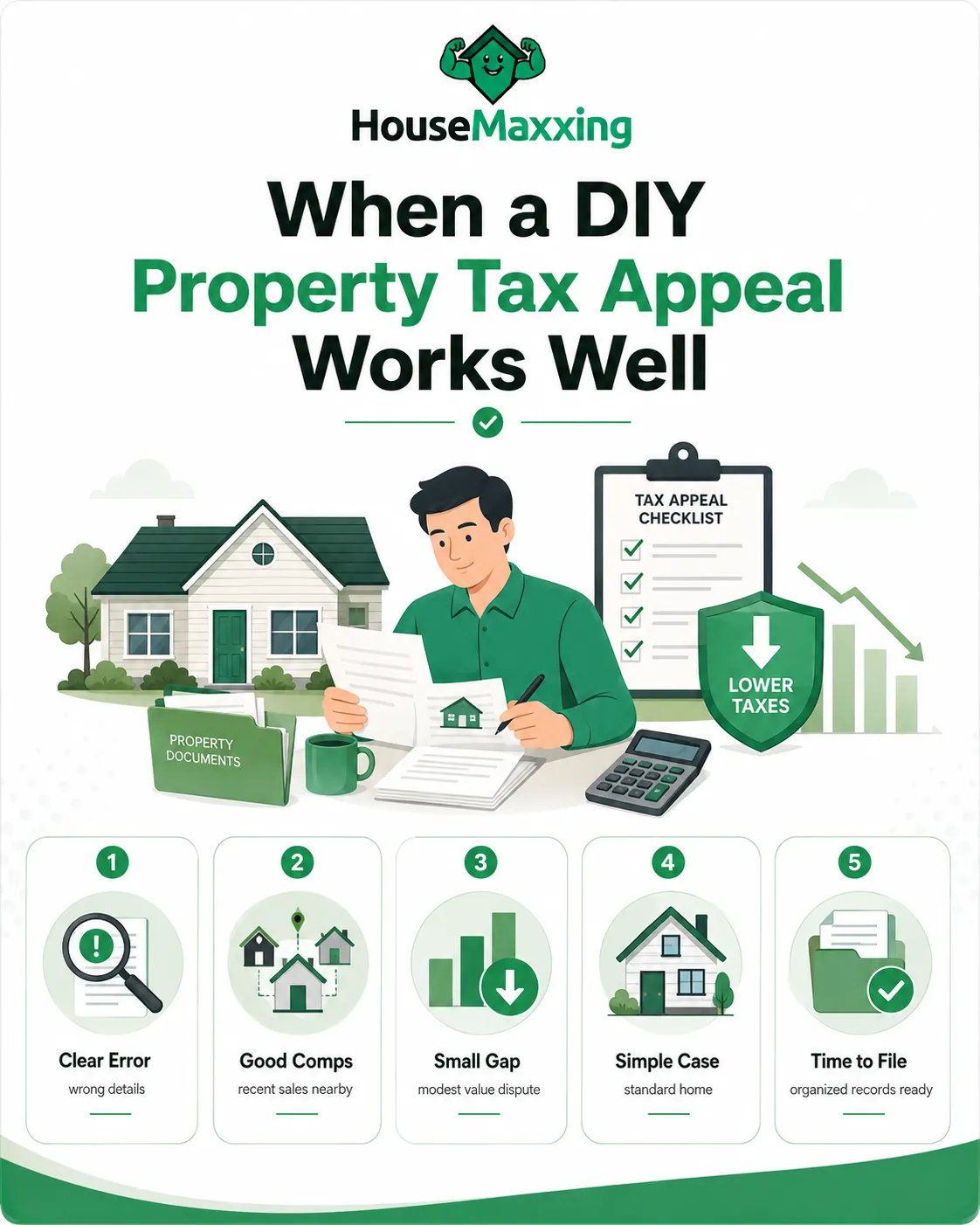
A DIY appeal is often practical when you own a single-family home, the issue is easy to explain, and you can support it with documents. You remain in control of the filing, the evidence, and the decision to move forward. For a step-by-step walkthrough, see how to appeal property taxes.
You May Be a Strong DIY Candidate If
A self-filed appeal can make sense when your situation looks like this:
- You found a clear record error: County details conflict with your survey, floor plan, closing documents, or photographs.
- You have organized evidence: You can label exhibits and show why each record supports your requested correction.
- The process is administrative: You are filing an initial protest or grievance, not bringing a court case.
- The deadline is near: Filing yourself promptly may protect your right to review while you gather additional documents.
- The property is straightforward: A primary residence with ordinary features is often easier to compare than a specialized or income-producing property.
Online Records Can Help You Prepare
County property-search tools can help you gather public records, locate parcel information, and compare assessed or appraised figures. Use the same methodology across comparable homes instead of selecting only the few records that appear favorable. A useful comparison should identify the county source, the date you retrieved the records, and the similarities or differences between each property.
When You Should Consider an Attorney
Some property tax appeals involve more than a basic administrative review. An attorney may be worth considering when the dispute has legal consequences, high financial stakes, complicated ownership, or a move into a formal court process.
Legal Help May Be Worth Exploring When
An attorney can be more useful in situations such as:
- A court appeal or judicial review: Court rules, pleadings, deadlines, and evidentiary requirements may apply.
- Large commercial or income-producing property: Valuation issues can involve leases, income records, specialized property types, and expert testimony.
- LLC, trust, or corporate ownership: Ownership structure can affect filing rights and available appeal routes.
- A previous administrative denial: You may need help understanding the written decision and the next available option.
- A procedural dispute: Missed notices, contested authority, or a disagreement about filing requirements can raise legal questions.
Commercial Cases Often Need More Than a Form
Commercial and multifamily properties can involve complex facts that go beyond a homeowner’s county record. The evidence may include income and expense records, lease terms, construction data, or specialized valuation analysis. That does not mean every commercial owner needs a lawyer. It means the risks of a weak filing or missed procedural requirement can be higher. Request a written explanation of the attorney’s scope before hiring anyone.
Property Tax Consultant vs. Attorney: Know the Difference
A property tax consultant and a lawyer do not provide the same service. A consultant may help with local filing, records, or administrative process knowledge. An attorney can provide legal representation and legal advice within the jurisdictions where they are licensed.
Questions to Ask Before You Hire Anyone
Before signing an agreement, ask direct questions about the service:
- What exactly will you file or prepare?
- Will you appear before the county on my behalf?
- Do you need written authority from me?
- What fees apply, and when do they apply?
- Does the agreement renew automatically?
- What happens if no change occurs?
- Can I receive copies of all documents and source records?
Cost Comparison: Lawyer vs. Consultant vs. DIY vs. Housemaxxing
Each option handles cost, time, and risk differently. Here’s how they compare:
| Housemaxxing | Local Consultant | DIY (File Yourself) | Attorney | |
|---|---|---|---|---|
| Cost | One flat fee, charged only if we find an exemption beyond homestead | Often 25–50% of your savings, or hourly billing | Free to file, your only cost is your time | Hourly or flat-fee billing; rates vary by attorney and jurisdiction |
| Time | Under 60 seconds to start | Days to schedule and meet | Hours spent researching comps and forms | Varies; typically starts with a paid consultation |
| What’s Included | We research your exemptions and hand you the forms, deadlines, and filing instructions, you file | Expertise and service scope vary by firm | You handle the research, comps, and forms yourself | Legal representation and advice, within the jurisdictions where they’re licensed |
| Risk | Nothing found, nothing charged | Contract terms vary, read the agreement closely | Missed deadlines or weak evidence if done without care | Fees are typically owed regardless of outcome, unless the agreement says otherwise |
Make the Decision Before the Deadline Passes
The decision does not need to be complicated. First, read the notice. Next, identify the issue and gather records. Then decide whether the process remains simple enough for you to handle alone.
A Quick Decision Checklist
DIY may be the right path if you can answer “yes” to most of these questions:
- Do I understand the county decision I am challenging?
- Can I document the error or issue?
- Am I still within the local deadline?
- Is this an initial administrative filing rather than a court case?
- Can I follow the county’s filing instructions myself?
If the answer is no, or the matter involves court action, commercial property, or ownership complications, consult a licensed attorney in your state.
Housemaxxing Helps You Start With Better Information
A property tax appeal does not automatically require a lawyer. For many homeowners, the first practical step is understanding their county record, filing deadline, and possible exemptions. At Housemaxxing, we research public records to help homeowners identify exemptions beyond homestead, along with the county forms, deadlines, and filing instructions they may need. We do not file applications or represent you before a taxing authority. Ready to check for potential exemptions in your area? Housemaxxing serves homeowners with public-records exemption research and helps you prepare to file your own property tax appeal-related paperwork with your local county.





 Ask ChatGPT
  Ask Claude
  Ask Perplexity