


Your assessment notice arrived, the number looks wrong, and now you need to know one thing: do you still have time to act? Property tax appeal deadlines often arrive faster than homeowners expect, and missing one can limit your options for that tax year. Most counties and assessment authorities use a fixed filing window after they mail, deliver, or publish an assessment notice. That window is often around 30 to 45 days, but there is no national deadline. Your notice and local county website control.
Property Tax Appeal Deadlines Usually Have a Fixed Window
A property tax appeal deadline is the last day you can formally ask your local assessment authority to review an assessment, property-record error, or related decision. Once that date passes, your right to a routine review may close for the current cycle. In Texas, most property owners generally have until May 15 or 30 days after the appraisal district mails the notice of appraised value, whichever is later. In many New York communities, homeowners must file by the local Grievance Day, often the fourth Tuesday in May. These examples show why you must confirm the rule where your property sits. Act now: A deadline on a notice is more important than a deadline mentioned in a general article, social post, or neighbor’s advice. Check what you may qualify for before the deadline passes.
Why the Filing Window Is Short
Assessment offices need time to review property records, schedule hearings, finalize rolls, and send tax bills. As a result, the formal protest or grievance period usually comes before you receive the final bill. Waiting for your tax bill can be a costly mistake. The tax amount may feel like the urgent problem, but the assessment notice is usually where the appeal clock starts.
Your County Sets the Rule
Your county, municipality, appraisal district, or assessor determines the form, filing route, and deadline. Some areas count calendar days, while others use a specific annual date. Check whether the notice says “mailed,” “delivered,” “postmarked,” or “received.” That wording can matter.
Where to Find Your Property Tax Appeal Deadline
Your property tax assessment notice should identify the last day to protest, appeal, grieve, or request review. Read the entire notice rather than scanning only the assessed or appraised value.
Check These Parts of the Notice First
Start by looking for the following information:
- Mailing or delivery date: This may start the deadline clock.
- Parcel or account number: You need this when using an online portal or contacting the county.
- Assessment or appraised value: Compare it with the prior year and the county property record.
- Appeal instructions: Look for the form name, web address, office, and accepted submission methods.
- Deadline language: Save or screenshot this line immediately.
What Happens If You Miss a Property Tax Appeal Deadline?
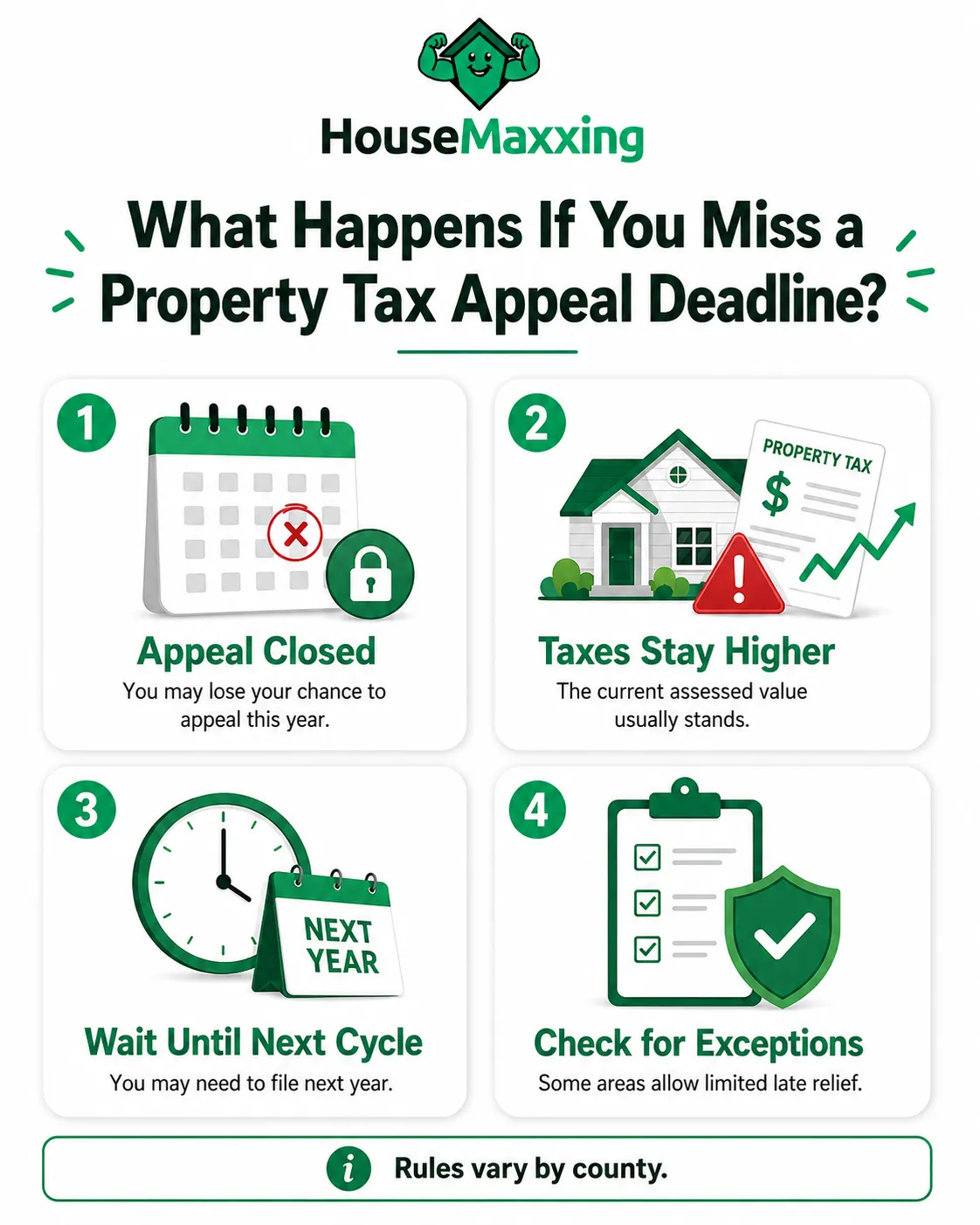
In many cases, missing the deadline means you lose the ordinary right to challenge that assessment for the current year. You may need to wait until the next assessment cycle to raise a new issue. That does not mean you should give up immediately. It means you should identify whether the county has a limited exception, correction process, or informal route that applies to your exact situation.
The Most Common Outcome: Wait Until Next Cycle
If no exception applies, the assessment normally remains in place for that tax year. You can still prepare for the next cycle by collecting records, confirming exemptions, and checking the county’s property details. Do not wait until next year’s deadline to start. Keep your current notice, repair receipts, photos, surveys, and any county correspondence in one folder.
Missing a Deadline Does Not Create a New Value Argument
You cannot usually reopen a closed filing period simply because you found more comparable properties or disagree with the assessment. A late request often needs a specific reason allowed by local rules. Your personal financial situation also may not be relevant to an assessment appeal. Focus on the county’s property record, exemptions, classification, or applicable assessment process.
Review the Decision and Calendar the Next Date
If your formal option has closed, add next year’s expected assessment period to your calendar. Set two reminders: one before notices typically arrive and another shortly after. You will have more time to review records, decide whether there may be grounds to protest, and file on time.
Are Late Property Tax Appeal Options Ever Available?
Some jurisdictions allow limited late-file options, but they are not automatic. The rules may apply only to specific circumstances, such as a required notice never arriving, a clerical error, an ownership issue, or good cause for missing the deadline.
Ask About the Correct Remedy
Contact the local authority and explain the facts without making assumptions. Ask whether the office offers any of the following:
- A late protest or late grievance process
- A correction-of-error procedure
- An informal review
- A process for a missed notice
- A separate exemption filing or late exemption application
An informal conversation may help you understand the record, but it does not necessarily preserve a formal appeal right. Ask whether an informal review changes the formal deadline. Usually, it does not.
File What You Can Before Time Runs Out
If the deadline is close, file the required form first and add evidence later only if local rules permit it. Keep your online confirmation, email receipt, certified-mail record, or stamped copy. For a full filing walkthrough, review how to appeal property taxes.
Keep Your Explanation Factual
If you request a late review, provide documents that support your reason. For example, include proof of an incorrect mailing address, a dated notice, or other records the local authority requests. Do not claim that a late option applies until the county confirms it. Local rules control.
The Week Your Notice Arrives: Your Five-Step Checklist
The first week after your notice arrives is the best time to protect your options. Take these steps before the deadline becomes urgent.
- Save the notice. Download, scan, or photograph every page, including the mailing date and instructions.
- Calendar the deadline. Set a reminder at least seven days before the deadline, not on the deadline itself.
- Check basic property details. Review square footage, lot size, bathrooms, condition, ownership, and exemptions.
- Gather your evidence. Collect surveys, closing documents, photographs, repair estimates, and county records that directly support your issue.
- Confirm your filing method. Determine whether the county requires an online form, mail delivery, in-person filing, or supporting documents by a separate date.
Compare Your Options Before the Deadline Closes
You do not need to overcomplicate a straightforward property tax appeal. The right path depends on the problem, the evidence, and how much time remains.
| Your situation | Practical next step | What to avoid |
|---|---|---|
| Clear property-record error | File the county form and attach the supporting record | Waiting for the tax bill |
| Missing or denied exemption | Review the county’s exemption instructions and deadline | Assuming an appeal form is the same as an exemption form |
| Deadline is days away | Submit the required filing and save proof of submission | Waiting until every document is perfect |
| Deadline already passed | Ask the county about a specific late-file or correction process | Assuming an informal call reopens the deadline |
Your Filing Stays Yours
You can research your options, collect records, and submit your own paperwork. A strong filing is clear, timely, and supported by documents that relate directly to the county decision. Public records can help you understand county assessed or appraised figures. They do not replace an appraisal or guarantee an outcome.
Housemaxxing Helps You Prepare Before Time Runs Out
Property tax appeal deadlines matter because a missed deadline can remove your easiest chance to ask for a review. The best response is simple: read your assessment notice, confirm the local date, and act before the filing window closes. At Housemaxxing, we research public records to identify property-tax exemptions you may qualify for beyond homestead. We provide the relevant county forms, deadlines, and filing instructions, while you remain the person who files your own application. Want to check for possible exemptions before your property tax appeal deadline? Start your free Housemaxxing address check. Housemaxxing serves homeowners with public-records exemption research and does not file or represent homeowners before taxing authorities.






 Ask ChatGPT
  Ask Claude
  Ask Perplexity