
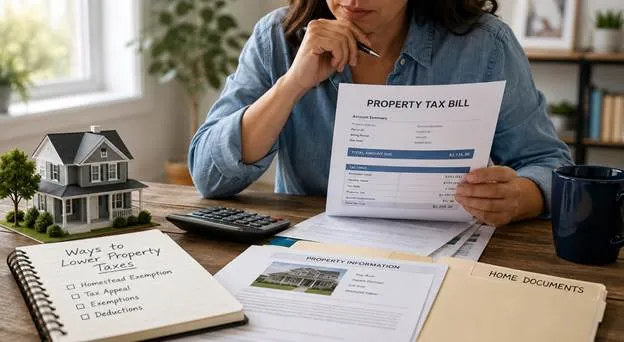

If you’re looking for ways to lower property taxes, you’re not alone. Every year, millions of homeowners open their tax bill and ask the same question: “Am I paying more than I should?”
It’s a fair question.
Property taxes are one of the highest ongoing costs of owning a home, yet they’re also one of the least understood. Many homeowners assume the amount on their bill is final. Others believe the only option is to accept it and pay.
There are legitimate ways to reduce your property tax bill. They don’t involve loopholes or avoiding payment. In most cases, it comes down to three things:
- Making sure your property’s assessed value is accurate.
- Claiming every exemption you qualify for.
- Catching mistakes before they cost you money.
That’s exactly what this guide covers.
Whether you just received an assessment notice, bought your first home, or simply haven’t reviewed your property taxes in years, this guide will help you understand where to start and what to do next.
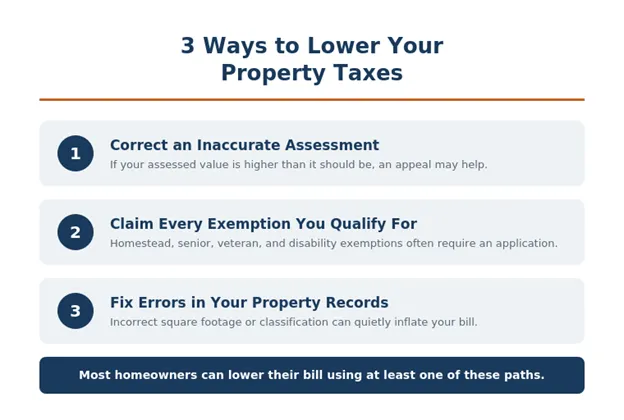
Three Ways to Lower Your Property Taxes
When homeowners ask how to lower property taxes, they’re usually looking for one simple answer. In reality, there are three. Once you understand these three paths, the process becomes much less confusing.
1. Correct an Inaccurate Property Assessment
Your property tax bill starts with your property’s assessed value.
If your county believes your home is worth more than it should be for tax purposes, you may end up paying more than necessary.
This doesn’t mean every high assessment is wrong. Counties follow set valuation rules and schedules, and market conditions differ from one area to another.
However, assessments can sometimes be based on outdated information, incorrect property records, or comparisons that don’t accurately reflect your home.
If something about your assessment doesn’t seem right, the first step is understanding how a property tax assessment appeal works before deciding whether an appeal makes sense.
2. Claim Every Property Tax Exemption You Qualify For
One of the biggest misconceptions about property taxes is that every eligible exemption is applied automatically. That’s rarely the case.
Many exemption programs require homeowners to apply, submit supporting documents, or meet filing deadlines established by their county or state. The National Conference of State Legislatures tracks how these relief programs vary from state to state.
Depending on where you live, exemptions may be available for:
- Homeowners (homestead exemption)
- Seniors
- Veterans
- People with qualifying disabilities
- Surviving spouses
- Other state-specific programs
Even qualifying for one exemption could reduce your taxable value and lower future property tax bills.
If you’ve owned your home for years but have never reviewed your exemption eligibility, this is often one of the easiest places to start.
3. Check Your Property Records for Errors
Sometimes the problem isn’t your property assessment. It’s the information used to create it.
County records aren’t perfect. They’re built over many years using permits, inspections, ownership records, and data entered by different people. The International Association of Assessing Officers recommends that county data be reviewed and updated on a regular basis for exactly this reason.
Small mistakes can happen.
Review details like:
- Square footage
- Lot size
- Number of bedrooms and bathrooms
- Garages and detached structures
- Finished basements
- Property classification
For example, if your county records show your home is larger than it actually is, your assessed value may be based on incorrect information. The IAAO’s Standard on Data Quality sets the accuracy benchmarks county offices are expected to follow for details like square footage.
Likewise, if your property is classified incorrectly, your tax bill may not accurately reflect your home’s situation.
Taking a few minutes to review your public records can help you identify errors before they affect future assessments.
What Doesn’t Lower Property Taxes
The National Taxpayers Union Foundation estimates that a large share of homes are over-assessed, and most owners never challenge it. Property taxes are also a major funding source for local governments, and the Tax Foundation tracks how property tax bills vary widely by state and county, which is part of why the same fix doesn’t work for every homeowner.
When homeowners start looking for ways to lower property taxes, they often come across advice that sounds convincing but simply isn’t true.
Some myths have been passed around for years. Others spread quickly online without explaining how property taxes actually work. Here are a few common misconceptions.
Myth #1: “If I Ignore My Tax Bill, It’ll Go Away.”
Unfortunately, it won’t. Property taxes are a legal obligation. Ignoring your bill can lead to penalties, interest, or other collection actions depending on your local laws.
If you believe your bill is incorrect, the better approach is to review your assessment, check your eligibility for exemptions, or learn about your county’s appeal process before any filing deadlines pass.
Myth #2: “My Neighbor Pays Less, So My Bill Must Be Wrong.”
Not necessarily. Two similar homes can have different property tax bills for perfectly legitimate reasons.
For example, your neighbor may qualify for a homestead exemption, purchased their home under different assessment rules, or benefit from state laws that limit annual assessment increases.
Comparing similar properties can help you spot potential issues, but it shouldn’t be your only source of information.
Myth #3: “The County Automatically Applies Every Exemption.”
This is one of the biggest misunderstandings homeowners have. While some jurisdictions automatically apply certain benefits, many exemptions require homeowners to submit an application and meet specific eligibility requirements.
That includes:
- Homestead exemptions
- Senior exemptions
- Veteran exemptions
- Disability exemptions
Missing an application deadline could mean waiting until the next tax year to receive the benefit.
Myth #4: “A Higher Home Value Always Means Higher Property Taxes.”
Not always. Your property’s market value is only one part of the equation.
Your assessed value, local tax rate, state laws, and any exemptions you qualify for all play a role in determining your final tax bill.
That’s why understanding how your county assesses property is just as important as knowing what your home might sell for. The Lincoln Institute of Land Policy offers a helpful breakdown of how these factors interact across different states. Separately, the IRS notes that real property taxes are generally deductible on federal returns only when levied uniformly for the general public welfare, which is a separate question from what your county charges you.
Not sure which path is right for you?
A free address analysis can help you understand which county and state property tax exemptions may apply to your property. In about 30 seconds, HouseMaxxing researches available programs and organizes the results into a personalized report, so you have a clearer idea of where to start.
Check your address to see what may apply
Start Here: Which Option Fits Your Situation?
Not every homeowner needs to take the same path. Use this quick guide to decide where to begin.
I Just Received a Property Assessment Notice
Start here:
- Review your assessed value.
- Compare it with similar homes.
I’m a New Homeowner
Start here:
- Check whether you’re eligible for a homestead exemption.
- Review other county and state exemption programs.
I’ve Owned My Home for Years but Have Never Checked for Exemptions
Start here:
- Review your eligibility for homeowner exemptions.
- Make sure you haven’t missed any application deadlines.
My Property Tax Bill Suddenly Increased
Start here:
- Review your property’s public records.
- Verify square footage, lot size, and property classification.
- Compare your assessment with similar homes before deciding whether an appeal is appropriate.
Final Thoughts
There isn’t one universal way to lower property taxes. For some homeowners, the answer is correcting an inaccurate assessment. For others, it’s claiming an exemption they never realized they qualified for. Sometimes, it’s as simple as correcting outdated property records before they affect future tax bills.
The important thing is knowing which path fits your situation. Instead of guessing, start with the facts. Review your assessment, check your records, and make sure you’re receiving every benefit available under your county and state rules.
What property tax exemptions could your address unlock that you haven’t claimed yet? In about 30 seconds, HouseMaxxing researches county and state exemption programs that may apply to your property and organizes the results into a personalized report. You stay in control of filing any applications, and if nothing is found beyond the standard homestead exemption, you don’t pay.




 Ask ChatGPT
  Ask Claude
  Ask Perplexity