


A homestead exemption could be one of the simplest ways to lower your property taxes. But many homeowners never apply for it. If you’re paying property taxes on your home, there’s one question worth answering before you accept the bill: Are you receiving every tax benefit your address qualifies for? If you own and live in your home as your primary residence, you may qualify for a benefit that reduces your taxable value or tax burden. The catch: eligibility, savings, and deadlines vary by state and county. That means the exemption your neighbor receives may not be the one you qualify for. And assuming your county applied it automatically could mean leaving money on the table. This guide shows you how to check whether you qualify, where to apply, what documents you may need, and how potential savings work.
What Is a Homestead Exemption?
A homestead exemption is a property tax benefit available to qualifying homeowners who use a property as their primary residence. Depending on the jurisdiction, it may reduce taxable value, lower the property taxes owed, or provide other protections. The exact benefit is not the same everywhere. For example, the Georgia Department of Revenue says a qualifying homeowner generally must own and occupy the home as their legal residence. They must also file with the appropriate county tax officials. Florida says eligible homeowners may receive a homestead exemption that reduces taxable value and may also qualify the property for the state’s Save Our Homes assessment limitation. So the better question isn’t “How much is the homestead exemption?” It’s “What homestead exemption applies to my address?”
What Can a Homestead Exemption Affect?
Depending on your state and county, a homestead program may:
- Reduce taxable value
- Reduce the property taxes you owe.
- Limit certain assessment increases.
- Work alongside other property tax exemptions.
- Provide additional benefits for qualifying homeowners.
- Allow certain tax benefits to transfer when you move, where portability is available.
Florida, for instance, connects its homestead exemption to the Save Our Homes assessment limitation, per the Florida Department of Revenue.
Check your county: Your local assessor, property appraiser, tax assessor, or similar office should have the current rules, filing deadline, exemption amount, and application instructions for your property.
Who Qualifies for a Homestead Exemption?
The most common starting point is simple: you own the home and use it as your primary residence. But that doesn’t automatically mean you qualify. Your state or county may also consider:
- When you purchased and began occupying the home.
- Whether it’s your legal or primary residence.
- Whether you already claim a homestead elsewhere.
- Whether you applied before the local deadline.
For example, Georgia’s guidance requires owning the property as of January 1 and occupying it as your legal residence, and you can’t already claim a homestead exemption elsewhere. Other jurisdictions use different dates. Primary residence does not always mean automatic approval; you may still need to file and prove you meet the requirements.
What If You Own More Than One Property?
Owning multiple properties doesn’t disqualify you; the key question is which property is your primary residence. A rental, vacation home, or investment property generally doesn’t qualify simply because you own it. Check your county: Confirm which property your local rules consider your primary residence before applying.
Not Sure If Your Home Qualifies?
This is where many homeowners waste time. They search county websites, compare exemption rules, and try to figure out which programs apply to their situation. You can start with your address instead. We research county and state property tax exemption programs that may apply to your property and organizes potential opportunities into a personalized report. Check your property exemption in about 30 seconds.
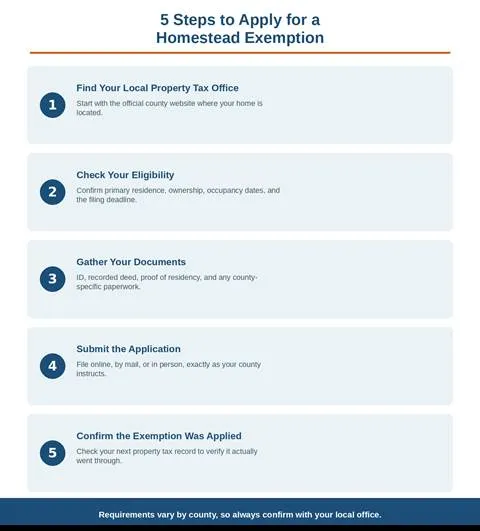
How to Apply for a Homestead Exemption
Don’t assume the exemption will appear automatically. In many jurisdictions, homeowners must submit an application to the office responsible for property tax administration. Georgia, for example, says homestead applications are filed with county tax officials. Florida directs homeowners to the property appraiser in the county where the property is located. The exact process depends on where you live.
Step 1: Find Your Local Property Tax Office
Start with the official government website for your county. The Georgia Department of Revenue’s county property tax facts page is a good example of what these directories look like. Look for terms like homestead exemption, property appraiser, or county assessor.
Step 2: Check Your Eligibility
Confirm the property qualifies as your primary residence, you meet ownership and occupancy requirements, and you’re applying before the deadline. Deadlines vary significantly; Georgia’s guidance identifies April 1 as the standard deadline, while other states use different dates entirely. Your county’s deadline is the one that matters.
Step 3: Gather Your Documents
The exact document list varies by jurisdiction, but common requirements include identification, a recorded deed, and proof of residency. See the full documents checklist below before you start collecting paperwork.
Step 4: Submit the Application
Apply online, by mail, or in person, exactly as your local office instructs. Don’t use a form from another county or state just because it has the same name.
Step 5: Confirm the Exemption Was Applied
Submitting isn’t the final step. Once it’s processed, check your property tax record to confirm the exemption appears, and keep your confirmation as proof of what you submitted.
What Documents Do You Need?
There is no single nationwide document checklist. Your local office decides what it needs to verify your eligibility. You may be asked for:
- Proof of identity (such as a driver’s license)
- Proof of ownership (a recorded deed)
- Proof of residency
- Property identification information (parcel or account number)
- Vehicle registration
- Trust or ownership documents, where applicable
- Additional documents for special exemptions
For example, Georgia says required documents vary by county or city and may include a driver’s license, vehicle registration, recorded deed, and trust documents in certain cases, per the Department of Revenue’s property tax FAQ.
The safest approach: check the official document list before you apply. That can prevent delays caused by missing paperwork.
How Much Can a Homestead Exemption Save You?
This is the question most homeowners want answered. The honest answer: it depends. There is no single national savings amount. Your potential benefit depends on your home’s taxable value, the exemption amount available in your area, local tax rates, and whether you qualify for additional exemptions or assessment protections. Florida, for example, says its homestead exemption may reduce taxable value by as much as $50,000. It can also qualify the property for the Save Our Homes assessment limitation, according to the Florida Department of Revenue. That’s a Florida-specific benefit, not a nationwide savings figure.
A Simple Example
Imagine a hypothetical county gives an eligible homeowner a $25,000 reduction in taxable value. If the property tax rate were 1%, that reduction could represent about $250 in annual savings. But that’s only an example. A $25,000 exemption does not mean you save $25,000. The exemption reduces taxable value. Your actual savings depend on the tax rates and rules that apply to your property.
Check your county: Look for the official exemption amount and confirm which parts of your property tax bill it affects.
Look Beyond the Basic Exemption
The standard homestead exemption may not be the only benefit available. Florida, for example, lists additional property tax benefits for seniors, veterans, and people with disabilities. Checking only for the basic exemption may leave other opportunities undiscovered.
Do You Have to Renew a Homestead Exemption?
Not always. Some jurisdictions automatically renew an approved exemption as long as you remain eligible. Others require an annual application or action after certain changes. Georgia says most approved homestead exemptions automatically renew while the homeowner continues to occupy the home under the same ownership. Florida also provides specific forms for homestead renewal. The important point: don’t assume the rules are the same everywhere.
Changes That May Affect Your Exemption
Review your exemption status if you sell your home or buy another primary residence. The same goes if you change ownership or stop using the home as your primary residence.
Check your county: A change in ownership or residency can affect an exemption even if you previously qualified.
What Is Homestead Portability?
Homestead portability refers to rules in some jurisdictions that allow certain homestead-related tax benefits to transfer when a homeowner moves to a new primary residence. It is not available everywhere. Florida is one example of a state with portability rules, governed under the state’s property tax administrative rules. While the homestead exemption itself is not transferable, eligible homeowners may be able to transfer all or part of the assessment difference to a new Florida homestead. Portability may involve its own eligibility requirements, application, filing deadline, and transfer limits. If you recently sold a home and purchased another, don’t assume you have to start from zero.
Check your state and county: Search for both “homestead exemption” and “homestead portability.”
Common Homestead Exemption Myths
A few misconceptions cause homeowners to miss out on real savings. Here are the most common ones.
Myth #1: “My County Applies It Automatically.”
Rarely. Most jurisdictions require homeowners to file an application, even for the basic exemption. Assuming it’s automatic is one of the most common reasons homeowners miss out.
Myth #2: “I Can Claim It on My Vacation Home.”
Generally no. A homestead exemption applies to your primary residence, the home you actually live in, not a second home, rental, or investment property.
Myth #3: “Once Approved, I Never Need to Check Again.”
Not necessarily. Some exemptions renew automatically, but others require action after a move, an ownership change, or a new tax year. Assuming nothing has changed can cost you the benefit.
Myth #4: “Every State Offers the Same Savings.”
Not close. Exemption amounts, eligibility rules, and deadlines vary widely by state and county; what your neighbor in another state receives may look nothing like what’s available to you.
Start Here: Which Option Fits Your Situation?
Not every homeowner needs to take the same path. Use this quick guide to decide where to begin.
I Just Bought a Home
Confirm your ownership record is updated, confirm the home is your primary residence, and check the filing deadline before you gather documents and submit your application. Recently purchased properties may need extra attention since local ownership records may not update immediately.
I’ve Lived in My Home for Years but Never Applied
Don’t assume you’ve missed your chance. Check whether your county offers a homestead exemption, confirm your home is listed as your primary residence, and find out whether you can still apply for the current or next tax year.
I Own a Rental or Second Home
Start by identifying which property is actually your primary residence. Don’t claim the same primary-residence benefit on multiple properties unless local law specifically permits it, and check whether a different tax program applies to the other property.
I’m a Senior Homeowner
Don’t stop after checking the standard homestead exemption. Your state or county may offer additional benefits based on age, income, or residence. The same applies to veterans, people with disabilities, and surviving spouses.
Final Thoughts
A homestead exemption can be a valuable way to lower your property taxes, but the benefit only helps if you qualify and claim it. The process is usually straightforward: check your eligibility, find your local application, file before the deadline, submit the required documents, and confirm the exemption was applied. Then look beyond the basic exemption. You may qualify for additional programs based on your age, disability, veteran status, or income. The expensive mistake is assuming your current property tax bill is simply the amount you have to accept. The better move is to check what your address qualifies for.
Find the Property Tax Savings You May Be Missing
In about 30 seconds, HouseMaxxing researches county and state property tax exemption programs that may apply to your property and organizes the findings into a personalized report. You stay in control of filing any applications. And if nothing is found beyond the standard homestead exemption, you don’t pay. You can see which tax savings you may be missing based on your property and location.




 Ask ChatGPT
  Ask Claude
  Ask Perplexity