


Your assessment notice shows a number that feels too high, but you are not sure what to challenge or where to start. A property tax assessment appeal gives you a formal way to ask your county, assessor, or appraisal review body to review the assessed value, property record, exemption decision, or unequal assessment issue. The process is usually more practical than it sounds. You need a timely filing, a clear reason for the appeal, and records that support your position. This guide explains how to challenge an assessed value without confusing it with your tax bill.
Property Tax Assessment Appeal: Start With the Right Number
A property tax assessment appeal focuses on the value or assessment your local authority assigned to your property. It does not automatically challenge the tax rate, county budget, school levy, or every charge shown on a tax bill. Your assessment may be based on market value, a percentage of market value, or a local appraisal method. The exact terminology and rules vary, so read your notice carefully and verify the process with your local county.
Assessed Value vs. Market Value: The Plain-Language Difference
Market value generally refers to what a property could sell for under normal conditions. Assessed value is the value or percentage of value your local authority uses to calculate property taxes. In some communities, the assessed value and market value may be close or identical. In others, the county applies a consistent percentage of market value to all similar properties.
| Term | What it means | Why it matters in an appeal |
|---|---|---|
| Market value | A property’s likely sale price under normal conditions | Comparable sales may help support or question the county’s estimate |
| Assessed value | The figure used in the tax calculation | This is often the number you formally challenge |
| Tax rate | The rate adopted by taxing bodies | An assessment appeal usually does not change it |
| Tax bill | The amount due after value, exemptions, and tax rates interact | It may show the result, but it is not always the appeal starting point |
Why Your Tax Bill Can Rise Even If the Rate Did Not
Your tax bill can increase because the assessed value changed, an exemption changed, or a local tax rate changed. These are separate moving parts. If the county record is wrong or the assessment appears inconsistent with relevant records, you may have grounds to protest. If the assessment is accurate but you disagree with the tax rate, the appeal process may not solve that separate concern.
Start With the Assessment Notice
Do not wait for the final tax bill. Assessment notices often include the filing deadline, parcel number, appeal form, and instructions for submitting evidence. Save the complete notice as soon as it arrives. That one document can determine whether you preserve your right to a review.
Grounds for Challenging an Assessed Value
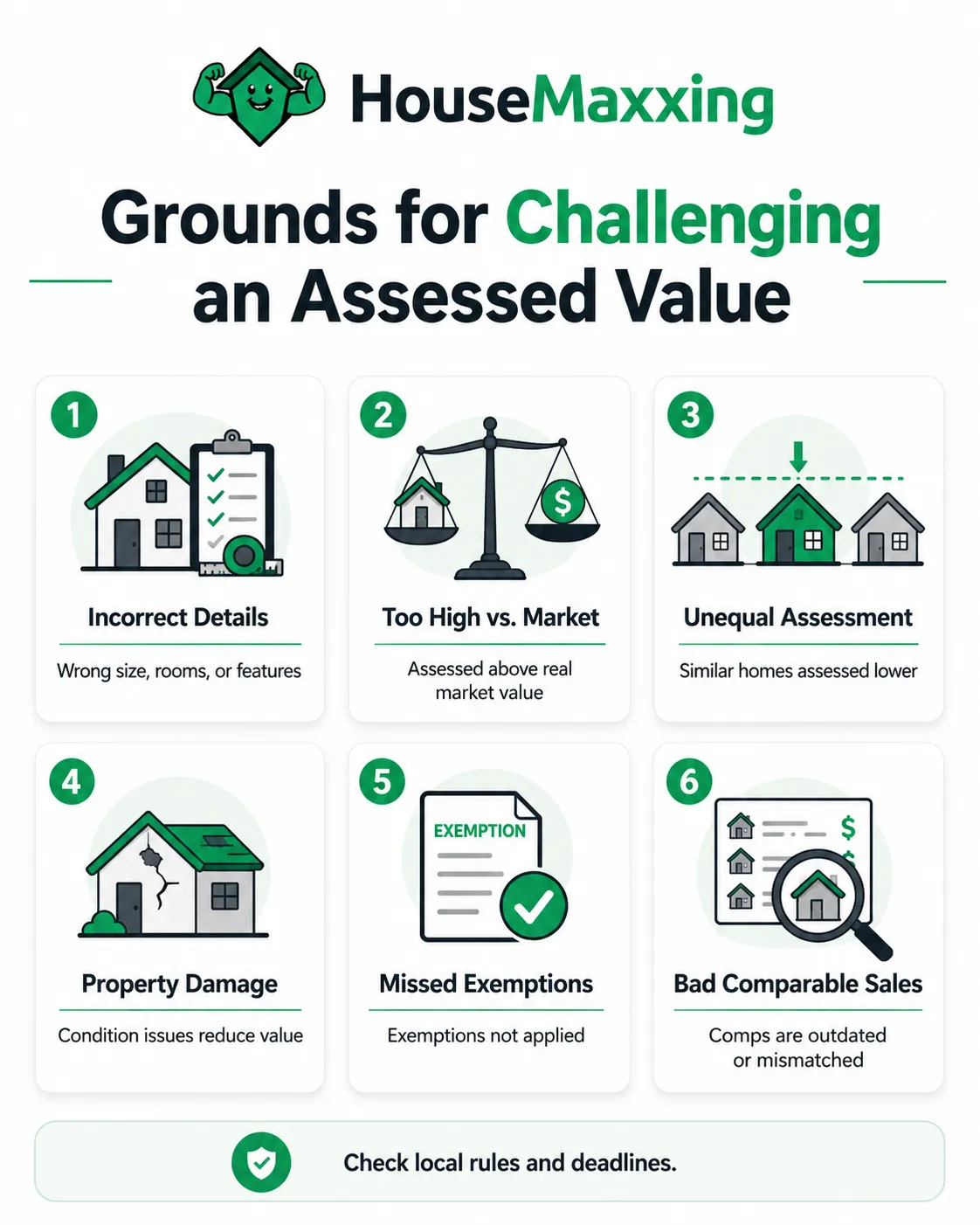
A successful property tax assessment appeal is built on a specific issue, not just a feeling that taxes are too high. Your evidence should connect directly to the county’s record or assessment method.
Common Reasons Homeowners Appeal
The strongest appeals often involve one or more of these issues:
- Incorrect property details: The county lists the wrong square footage, lot size, bathroom count, quality grade, or improvement.
- Condition problems: The record does not reflect damage, deferred maintenance, major repair needs, or a condition issue that existed on the relevant date.
- Comparable-sales evidence: Recent, similar sales suggest the county’s estimate may deserve review.
- Unequal assessment: Comparable properties appear to receive a lower assessment level than your property.
- Exemption or classification error: A valid homestead, senior, veteran, disability, or other exemption may be missing, reduced, or denied.
Overvaluation and Unequal Assessment Are Different
An overvaluation argument asks whether the assessed or appraised amount is too high based on relevant market information. An unequal assessment argument asks whether similar properties receive different assessment treatment. You may have one issue or both. Your local form may require you to select the grounds for the appeal, so use the county’s wording instead of inventing your own category.
Documents to Collect Before You File
Your evidence packet should be organized, factual, and easy to verify. Start collecting documents early, even if you plan to file online.
Build an Evidence Packet
Most homeowners should begin with these records:
- Assessment notice: Shows the value, tax year, parcel number, and deadline.
- County property record: Lets you check the details the assessor or appraisal district used.
- Comparable-sale information: Supports a market-based argument when the local process allows it.
- Comparable-assessment data: Helps you examine potential unequal treatment.
- Photos: Show visible condition issues, damage, or missing improvements.
- Repair estimates and invoices: Document material property conditions and costs.
- Survey, closing documents, permits, or blueprints: Help correct factual property-record errors.
- Exemption documents: Support an exemption-related issue or confirm eligibility requirements.
Check for Exemptions Before Filing
An assessment appeal and an exemption application are not always the same process. You may need different forms, deadlines, or proof for each. Before your filing window closes, check for potential exemptions. The free address check uses public records to identify possible county and state exemption programs; you decide whether to submit the application.
How to Choose Comparable Sales That Strengthen Your Case
Comparable sales can be useful, but only when they actually resemble your home and fit the county’s relevant time period. The goal is not to find the lowest sale price. The goal is to present a consistent, credible comparison.
Start With Similar Properties
Choose properties that share the most important features with yours. Prioritize:
- Same neighborhood or a genuinely similar nearby area
- Similar property type and home style
- Comparable square footage and lot size
- Similar age, condition, and quality
- Recent arm’s-length sale dates
- Similar bedroom, bathroom, garage, and improvement features
A home across town, a distressed sale, or a heavily renovated property may not offer a useful comparison. Note the differences instead of ignoring them.
Use a Complete Comparison Set
Do not present only the two or three homes with the lowest figures. Use a consistent screen, then keep every result that meets it, including properties that appear less favorable. That approach makes your evidence more transparent. It also helps you explain why one property is more comparable than another.
Sales Price Is Not the Only Fact That Matters
A sale price without context can mislead. Check whether the sale was recent, ordinary, and comparable in condition and location. If homes differ, explain the difference rather than assigning your own adjustment amount. Your county may have rules about how it evaluates comparisons, and those local rules control.
File Your Property Tax Assessment Appeal on Time
Filing methods vary, but counties commonly use an online portal, mail submission, in-person delivery, or a combination of these. Your assessment notice should identify the accepted method.
Common Filing Patterns
| Filing method | What to do | What to save |
|---|---|---|
| Online portal | Complete the form, upload documents, and submit before the deadline | Confirmation number and submission screenshot |
| Use the required form and send it early enough to meet local rules | Copy of filing and mailing proof | |
| In-person | Bring the completed form and supporting documents | Date-stamped accepted copy |
| Email or electronic delivery | Use only if the county specifically accepts it | Sent message, attachments, and acknowledgment |
Do not assume a county accepts a filing method because a neighboring county does. Verify the deadline, submission address, format, signature requirement, and evidence rules directly with your local authority.
File First if the Deadline Is Near
If you are close to the deadline, submit the required form before spending additional days perfecting every exhibit. Follow local instructions on whether you can add evidence after filing. Keep proof of submission in the same folder as your notice. A portal receipt, a stamped copy, or mailing proof can matter if there is a later question about timing.
Use the County’s Own Terms
Some places use “protest,” while others use “grievance,” “appeal,” or “request for review.” Use the form and terminology your county provides. For a complete process walkthrough, see how to appeal property taxes.
What Happens After You File?
After you file, the county may review your documents informally, request more information, schedule a hearing, or issue a written decision. The timeline depends on the county, season, and type of appeal.
Informal Review May Come First
Some assessors or appraisal districts offer an informal discussion before a formal hearing. Use it to clarify factual errors and understand the records used for your assessment. An informal conversation does not always extend the formal deadline. File the required protest or grievance on time unless the county confirms otherwise.
Prepare for a Hearing if Needed
At a hearing, you may present documents, explain the issue, and answer questions. Bring the required number of copies and follow local rules for virtual, written, or in-person appearances. Start with your main issue. Then refer to your exhibits in order. A short, factual explanation is stronger than a long emotional argument.
Review the Written Decision
The local authority should send a decision or next-step notice after review. Read it promptly because a further appeal, arbitration option, or judicial review may have a separate deadline. A partial result can still matter. The county may correct one fact, approve an exemption, or adjust part of the assessment without agreeing with every point you raised.
Avoid the Mistakes That Weaken Good Appeals
You do not need perfect expertise to file a clear property tax assessment appeal. You do need to avoid preventable mistakes.
Keep These Rules in Mind
- Do not miss the deadline while gathering more documents.
- Do not challenge a tax rate through an assessment form unless local instructions say you can.
- Do not use only the most favorable comparable properties.
- Do not submit unlabeled photos or unexplained documents.
- Do not present a calculated number as an appraisal.
- Do not assume last year’s result or exemption automatically applies this year.
Ask One Clear Question When You Call
If you need help from the county, ask a specific procedural question: “What is the deadline and accepted filing method for this parcel?” Keep the call focused and record the answer.
Make Your Next Move With HouseMaxxing
A property tax assessment appeal gives you a practical path to challenge an assessed value when you have timely, relevant evidence. Start with the notice, verify the county record, organize your documents, and follow your local filing process exactly. At HouseMaxxing, we research public records to help homeowners identify possible exemptions beyond homestead, including the county forms, deadlines, and filing instructions they may need. We do not estimate your home’s market value, file your application, or represent you before a taxing authority. If you want to check for potential exemptions before your property tax assessment appeal deadline, start your HouseMaxxing address check.







 Ask ChatGPT
  Ask Claude
  Ask Perplexity