


Wondering whether to claim a homestead exemption or file a property tax appeal? You may not have to choose. These two options address different parts of your property tax situation.
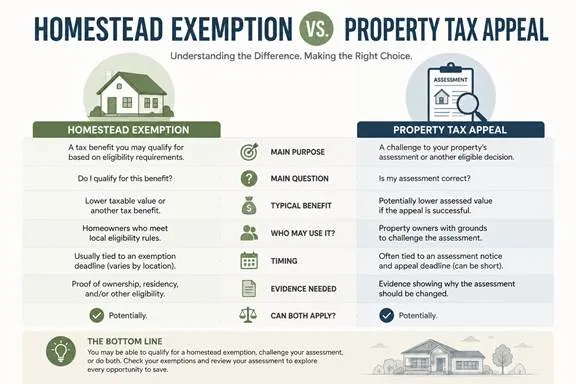
A homestead exemption asks, “Do I qualify for a tax benefit?”
A property tax appeal asks, “Is my property assessment correct?”
Knowing that difference helps in two ways. You avoid wasting time on the wrong process, and you avoid missing a chance to lower your tax bill.
Homestead Exemption vs. Property Tax Appeal: What’s the Difference?
A homestead exemption is a tax break for the home you live in, if you qualify. Depending on where you live, it may lower your taxable value or cut your taxes another way. A property tax appeal challenges an assessment or another decision you can contest. The steps and the reasons you can appeal differ by state and by county. For example, Texas lets property owners protest the value an appraisal district sets. You can also protest certain other actions the district takes on your property. New York also tells homeowners to review their assessment. The state explains how to challenge it if you think it is unfair. Your local rules control the details. Check with your county or local tax office before you act.
Side-by-Side Comparison
Category | Homestead Exemption | Property Tax Appeal |
|---|---|---|
Purpose | Claim a tax benefit | Challenge an assessment or eligible decision |
Main question | Do I qualify? | Is my assessment correct? |
Potential benefit | Lower taxable value or other tax relief | Potentially lower assessed value |
Typical evidence | Ownership and residency information | Evidence supporting your challenge |
Timing | Exemption deadline | Assessment or appeal deadline |
Can both apply? | Potentially | Potentially |
What Does a Homestead Exemption Do?
A homestead exemption usually applies to the home you live in as your main home. The exact benefit differs from place to place. Some programs lower the taxable value used to figure your taxes. Others cut your taxes a different way. New York notes that exemptions may come from a city, a county, or a school district. The state tells homeowners to ask their local assessor which programs are offered. So do not assume that owning and living in your home gives you every benefit on offer. You may need to apply, send in papers, or meet a set deadline.
What Does a Property Tax Appeal Do?
A property tax appeal is how you challenge an assessment, or another decision you think is wrong.
Local rules decide what counts as a reason to appeal. You may have a case if the details on your property record are wrong.
The same is true if your property is in the wrong class. You may also have a case if the property tax assessment is higher than your local rules allow, if you have proof of a different value, or if an exemption was denied.
The International Association of Assessing Officers keeps professional standards for this work. They cover how property taxes are run and how property is valued.
But remember, a high tax bill does not always mean your assessment is wrong.
Tax rates, special charges, exemptions, and other local fees all shape your bill, too.
What Should New Homeowners Do First?
If you just bought a home, look at both your exemptions and your assessment. New York’s Department of Taxation and Finance tells new homeowners to do two things. Check which exemptions you can get, and get to know your property’s assessment. The state also urges you to review that assessment and learn how to contest it. A practical approach is to review both.
1. Check Your Exemptions
Look for a homestead exemption and other programs you may qualify for. Some are based on age, disability, or veteran status. Others depend on local rules.
2. Review Your Property Record
Check the address, the owner’s name, and the property class. Then check the square footage, lot size, main features, and the value on record. Mistakes here can throw off your assessment.
3. Check Your Appeal Deadline
Do this right away if you got an assessment notice. Do not wait until you finish looking into exemptions.
Deadlines differ a lot from place to place. In Texas, most owners have until May 15 to file a protest. If the appraisal district mails your notice of appraised value later, you get 30 days from that date instead. Other places set different deadlines.
Can You Use Both?
Potentially, yes. Having a homestead exemption does not mean your assessment is right. And challenging your assessment does not replace an exemption you qualify for. Florida is a good example. Florida’s Value Adjustment Board can handle both value disputes and some denied exemptions. Florida’s official taxpayer guide says owners can ask for an informal conference, file an appeal, or do both at once. So think about the two options separately:
Exemption: Am I receiving the benefits I qualify for?
Appeal: Is my property assessed correctly?
If both answers worry you, then you may have two things worth looking into.
Which Should You Do First?
There is no single answer that fits every homeowner. A smart plan is to check both, but guard your appeal deadline first. Start by checking whether your home qualifies for a homestead exemption. Then look over your property record and assessment. If something looks off, find out how and when you can appeal. This helps you dodge a common mistake. Some people spend weeks reading up on exemptions while their appeal deadline slips by.
How HouseMaxxing Can Help
The hard part is often working out what applies to your property.
You may qualify for a homestead exemption. You may qualify for other tax breaks, too. You may also have an assessment worth a closer look.
But digging through county websites and comparing programs takes time. HouseMaxxing looks up county and state tax exemption programs that may fit your address. Then it puts the findings into a report made for you. That gives you a place to start on the exemption side. To challenge an assessment, ask your local assessor or appraiser for the current appeal rules and deadline.
Final Thoughts
A homestead exemption and a property tax appeal are not rival options. They solve different problems.
An exemption asks whether you qualify for a tax benefit. An appeal asks whether your property assessment is correct.
For some homeowners, both are worth doing.
The best first move is simple. Check your exemptions, review your property record, and learn your appeal deadline.
HouseMaxxing can help you find out which exemptions your property may qualify for.






 Ask ChatGPT
  Ask Claude
  Ask Perplexity