


If you already claim a homestead exemption, you may have taken an important step toward lowering your property tax bill. But it may not be the only property tax benefit available to you.
Many states and local taxing authorities offer additional exemptions or tax relief programs for homeowners who meet certain requirements. These can include age, military service, disability, income, or other qualifying circumstances.
Some benefits may be available alongside a homestead exemption. Others have their own eligibility requirements or restrictions.
That makes one question worth asking:
Are you receiving every property tax benefit your property and circumstances may qualify for?
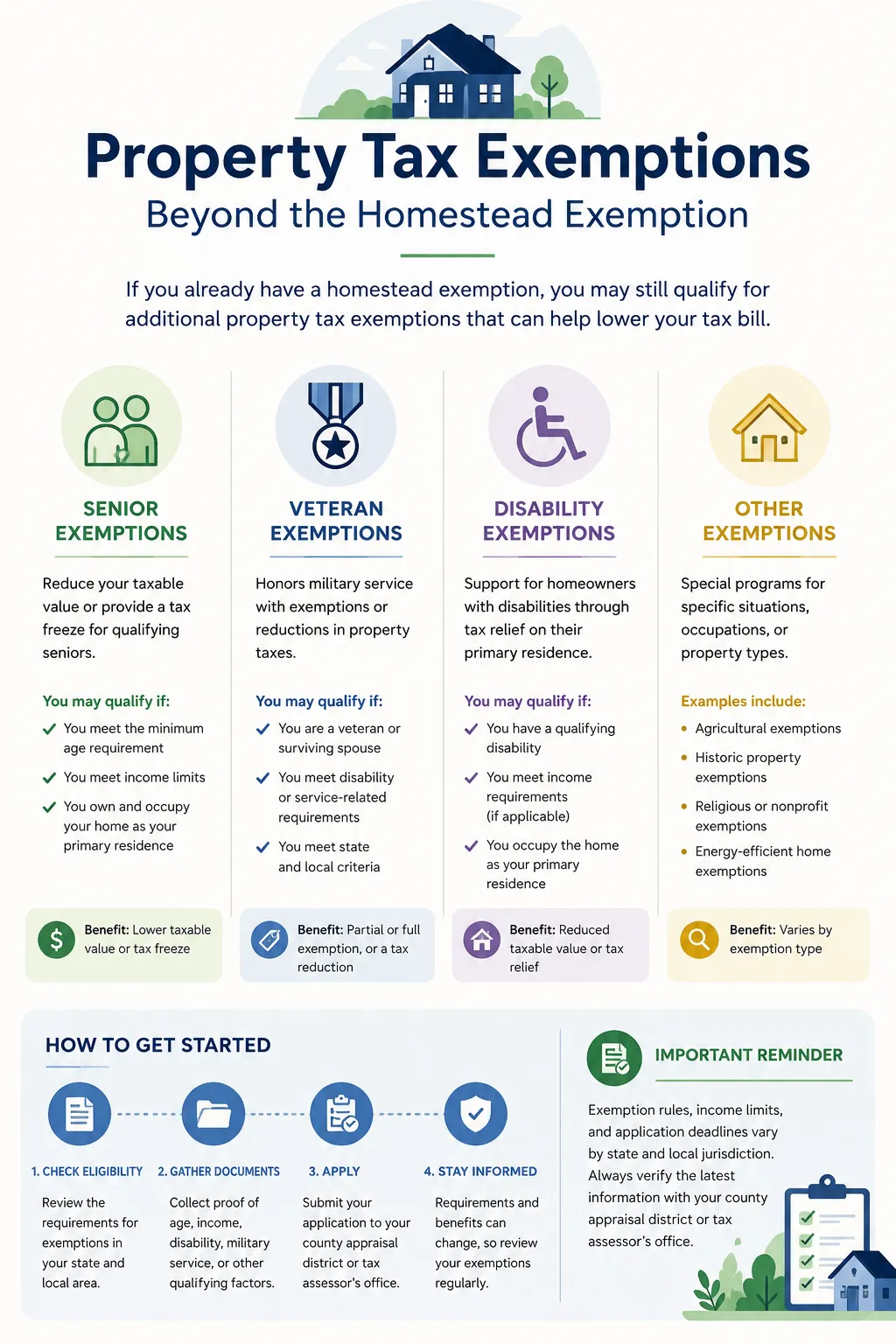
Senior, veteran, and disability exemptions can potentially reduce the amount of your property value subject to taxation. However, the rules are not the same everywhere.
Here is what to look for before assuming your current homestead exemption is all you can claim.
Senior Property Tax Exemptions
Many states and local taxing authorities offer property tax relief to homeowners who meet a certain age requirement. Age 65 is a common threshold, but there is no single nationwide senior exemption. Eligibility can also depend on factors such as ownership, residency, income, and whether the property is your primary residence. For example, Texas provides an additional residence homestead exemption for homeowners who are 65 or older. Texas also allows certain qualifying homeowners who are 65 or older to defer payment of property taxes on their residence homestead. New York also offers a senior citizens’ property tax exemption. Its state guidance explains that eligibility can depend on requirements including age, ownership, income, and whether the municipality has adopted the exemption.
What can affect senior exemption eligibility?
Depending on where you live, you may need to meet requirements involving:
Minimum age Property ownership Primary residence status Household income Local adoption of the exemption Application deadlines
Reaching the qualifying age does not necessarily mean an exemption will automatically appear on your tax bill. Some programs require an application and supporting documentation. If you already receive a homestead exemption, checking whether you qualify for an age-based benefit may be another way to potentially lower property taxes.
Veteran Property Tax Exemptions
Veterans may qualify for property tax benefits in many states, but the available programs can vary substantially. Some exemptions are based on qualifying military service. Others are specifically tied to a service-connected disability rating. Certain programs can also extend benefits to qualifying surviving spouses or family members. The U.S. Department of Veterans Affairs maintains a state-by-state overview of veteran tax benefits and notes that most states and territories provide some form of tax benefit for veterans, their families, or survivors. The VA also recommends verifying the current requirements with the relevant state agency because program details can change. For example, Texas has a disabled veteran exemption based on a veteran’s service-connected disability rating. The amount of the exemption varies according to the rating. Texas also provides a separate residence homestead exemption for certain veterans with a 100% disability rating or a determination of individual unemployability from the U.S. Department of Veterans Affairs. For qualifying veterans, this exemption can cover the total appraised value of the residence homestead. The rules are different from state to state, so a veteran should not assume that a benefit available in one state applies in another.
Service-connected vs. general veteran exemptions
This distinction matters when researching your options.
A general veteran exemption may be based on qualifying military service.
A disabled veteran exemption may require proof of a qualifying service-connected disability or a specific disability rating.
Some states offer both types of benefits. Others have more limited programs.
If you are a veteran, check your state and local property tax rules in addition to your homestead exemption. You may find a separate benefit that could reduce your taxable income.
Veteran property tax benefits vary by state, and the U.S. Department of Veterans Affairs notes that eligibility and available benefits depend on the state or territory where you live.
Disability Property Tax Exemptions
Homeowners with qualifying disabilities may also have access to property tax relief. However, there is no single nationwide definition of a qualifying disability for property tax purposes. Each state and local taxing authority can establish its own requirements. Some programs require proof of a particular disability classification. Others may connect eligibility to federal disability benefits, income requirements, residency, or other criteria. Texas, for example, provides a disabled person with a residence homestead exemption. To qualify, a person must meet the federal definition of disability used for disability insurance benefits under the Social Security system. The state also requires supporting documentation to establish eligibility. Texas treats this as a separate exemption from its disabled veteran exemption. A qualifying disabled veteran may potentially qualify for both programs, although the rules governing how benefits apply can differ. This is why having a disability does not automatically mean you qualify for every disability-related property tax benefit. If you have a qualifying disability, check the requirements that apply to your property and local taxing authorities. You may be eligible for a benefit that is not currently reflected on your property tax record.
Can You Combine a Homestead Exemption With Other Exemptions?
Sometimes, but not always. Whether you can combine exemptions depends on the laws and rules that apply to your property. Some jurisdictions allow certain exemptions to be added to a standard homestead exemption. Others limit which benefits can be combined or apply different exemptions to different taxing units. Texas provides a good example. An eligible disabled person who is also 65 or older may receive both the age-based and disability exemptions in the same year, but not from the same taxing units. This means that simply finding multiple exemptions is not enough. You need to determine which benefits apply to your property and how they interact with one another. The same combination that works in one state may not be available in another.
How to Find Property Tax Exemptions You May Qualify For
Start by reviewing your current property tax records.
Look for:
Your current homestead exemption status Your assessed value Your taxable value Existing exemptions or deductions Your local taxing authorities Application deadlines Any notices about changes to your assessment
Then consider whether your circumstances may qualify you for another category of relief.
That could include:
Senior or age-based exemptions Veteran exemptions Disabled veteran exemptions Disability exemptions Surviving spouse benefits Income-based property tax relief
Your eligibility can also change over time. Reaching a qualifying age, receiving a qualifying disability determination, becoming eligible for a veteran benefit, or experiencing another qualifying change may create an opportunity to review your exemptions again. Because exemption rules are location-specific, your next step should be to verify which programs apply to your property.
Your Homestead Exemption May Not Be the Whole Picture
A homestead exemption can reduce your taxable value, but it may not be the only property tax benefit available to you. Depending on where you live and your circumstances, you may qualify for additional relief based on your age, military service, disability, income, or another qualifying factor. The key is knowing what applies to your property, rather than assuming your current exemption is the maximum available.
See What Your Property May Qualify For
If you already have a homestead exemption, you may still have other property tax benefits worth checking. See what you may qualify for and find out if there are other ways you may be able to lower your property taxes.






 Ask ChatGPT
  Ask Claude
  Ask Perplexity