


Opening your property tax bill can feel like opening your electric bill in the middle of summer. You know it’s probably going to be higher than you’d like, and you’re already wondering how to lower property taxes before next year’s bill does the same thing. If you’ve looked at your latest bill and thought, “That can’t be right,” you’re not alone. Over the past few years, home prices have changed dramatically across many parts of the country. Counties have updated assessments, tax rates have shifted, and homeowners have become more aware of exemptions they never knew existed. As a result, many people are asking the same question: Am I paying more property tax than I should? The answer isn’t always straightforward. A higher tax bill doesn’t automatically mean there’s a mistake. Your property’s assessed value may have increased fairly, or your local tax rate may have changed. At the same time, errors in public records, outdated assessments, and missed exemptions can all contribute to paying more than necessary. Before you assume your tax bill is set in stone, there are a few warning signs worth checking. If you’re hoping to lower property taxes, start by checking whether any of these five signs apply to your home.
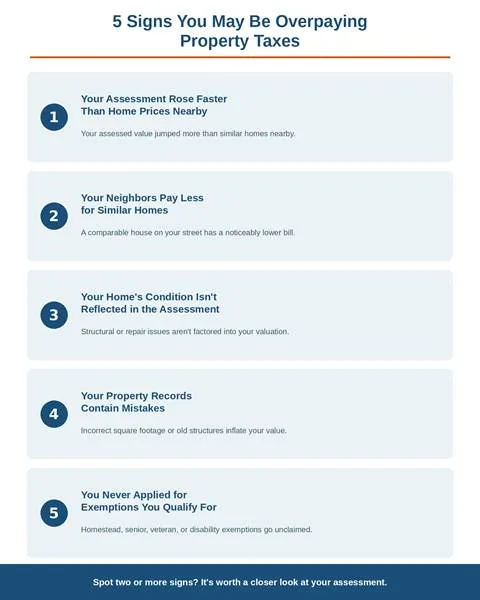
Sign #1: Your Assessment Rose Faster Than Home Prices Nearby
Property assessments naturally climb over time. It’s a different story when your home’s assessed value jumps well beyond what similar homes nearby have seen. That doesn’t automatically mean your county made a mistake. Property assessments follow local rules, and every jurisdiction has its own schedule and valuation process. Still, comparing your home with similar properties can help you spot potential red flags. When making comparisons, look for homes that are as similar to yours as possible, including:
- Square footage
- Lot size
- Age
- Location
- Overall condition
Identical properties rarely exist, so look for a pattern rather than a perfect match.
Maybe homes with similar features are consistently selling for less than your assessed value. Maybe your assessment increased much faster than comparable properties. Either way, it’s worth reviewing how your property was valued.
It’s the same logic as getting a second opinion from a doctor: you’re simply confirming the assessment still matches today’s market, not assuming something is wrong with it.
Sign #2: Your Neighbors Pay Less for Similar Homes
This is one of the most common reasons homeowners start asking questions. You mention your property taxes during a conversation with a neighbor. You discover they’re paying noticeably less for a house that’s almost the same size as yours.
Before jumping to conclusions, remember that tax bills aren’t always an apples-to-apples comparison. Your neighbor may qualify for tax exemptions that reduce their taxable value. They may have purchased their home years earlier under different assessment rules. Some states also have laws that limit how quickly assessed values can increase for certain homeowners. California’s Prop 13 cap is a well-known example. The Lincoln Institute of Land Policy tracks similar caps state by state.
Even so, comparing notes with neighbors can still be useful.
If several homes that are similar to yours consistently have lower tax bills, it’s worth finding out why. Sometimes the explanation is completely legitimate. Other times, it highlights an opportunity you didn’t realize existed.
For example, you may discover that many homeowners on your street receive a homestead exemption or another benefit that you’ve never applied for.
You’re checking whether your property is treated similarly to other comparable homes, not sizing yourself up against every house on the block.
Sign #3: Your Home’s Condition Isn’t Reflected in Its Assessment
Imagine two houses built in the same year on the same street. One has a recently renovated kitchen, new windows, a new roof, and updated plumbing.
The other has foundation cracks, an aging HVAC system, water damage in the basement, and a roof that’s well past its expected lifespan. Two homes can look similar on paper and still be worth very different amounts.
Property assessments are designed to estimate value. But public records don’t always capture changes that make a home less valuable. If your property has significant condition issues that aren’t reflected in the assessment, your taxable value may not tell the full story.
Some examples include:
- Foundation or structural problems
- Roof damage
- Water or flood damage
- Outdated plumbing or electrical systems
- Functional obsolescence that affects resale value
None of this guarantees you’re overpaying. But if the assessor never accounted for these issues, your assessment is worth a second look.
Ready to see what may apply to your property?
You could be paying more property tax than you need to. Find out whether your assessment may be too high and what options you have to challenge it.
Sign #4: Your Property Records Contain Mistakes
Even if your home is accurately assessed, mistakes in your property’s public record can still affect how it’s valued. It happens more often than many homeowners realize. County records are built from years of permits, inspections, ownership changes, and data entry. Along the way, information can become outdated or simply incorrect. While many records are accurate, even a small error can influence your property’s assessed value. The International Association of Assessing Officers maintains data-quality standards for exactly this reason. Take a few minutes to review details such as:
- Square footage
- Number of bedrooms and bathrooms
- Lot size
- Garages, sheds, or other structures
- Finished basement or additional living space
For example, if county records show your home has 2,600 square feet when it actually has 2,300, your assessment may be based on a larger home than the one you own. The same can happen if an old structure was demolished years ago, but still appears in the property’s record. Most county assessor websites allow homeowners to review this information online. That makes it easy to spot obvious discrepancies before your next tax bill arrives. Checking your property record won’t always uncover a problem. But if it does, correcting the information may help ensure your assessment is based on accurate facts.
Sign #5: You Never Applied for Exemptions You May Qualify For
When people think about paying less in property taxes, they usually think about appealing their assessment. But that’s only one piece of the puzzle. In many cases, the simplest way to lower property taxes is by claiming exemptions you already qualify for. These programs vary by state and county; the National Conference of State Legislatures maintains a state-by-state rundown. But some of the most common include:
- Homestead exemptions
- Senior homeowner exemptions
- Veteran exemptions
- Disability exemptions
- Surviving spouse exemptions
Many homeowners assume these benefits are applied automatically. They’re often surprised to learn that some exemptions require an application, supporting documents, or a filing before a specific deadline. Have you owned your home for several years without checking what exemptions are available? It’s worth taking a few minutes to find out. You may not qualify for every program. But discovering just one eligible exemption could reduce your taxable value and lower future property tax bills.
What Should You Do If You Notice One or More of These Signs?
Finding one warning sign doesn’t necessarily mean you’re overpaying. Finding several of them, however, is a good reason to investigate further. Start by gathering information before making assumptions. Compare your home’s assessed value with similar properties. Review your county’s property records for accuracy. Check whether you’ve claimed every exemption available to you.
These steps won’t guarantee lower property taxes. But they’ll give you a much clearer picture of whether your current tax bill reflects your property’s situation. If researching county programs and filing requirements feels overwhelming, you don’t have to figure it all out on your own. You can see what you may qualify for with a free HouseMaxxing address check. In about 30 seconds, HouseMaxxing researches county and state exemption programs that may apply to your property. It organizes the findings into a personalized report. You remain in control of filing your applications. If nothing is found beyond the standard homestead exemption, you don’t pay. Don’t Keep Paying More Than You Have To. Get Free Address Analysis Today.






 Ask ChatGPT
  Ask Claude
  Ask Perplexity