

Want to lower property taxes? Start with the number that drives your entire bill: your property’s assessed value. Before filing an appeal or searching for exemptions, it helps to understand where that number comes from.
Most homeowners don’t think about their assessment until the bill arrives, jumps from last year, or their neighbor pays less for a similar home. Those are fair questions, and the answer starts with how assessments actually work.
Counties follow established methods to estimate what a property is worth for tax purposes, but those estimates rely on large amounts of data, and data isn’t always right. That doesn’t automatically mean your assessment is wrong. It means you shouldn’t assume it’s right without understanding how it was calculated.
How Your Property Tax Bill Is Calculated
Despite how complicated property taxes can seem, the basic formula is simple.
| Property Tax Bill = Assessed Value × Local Tax Rate |
|---|
Your local tax rate is set by governments and taxing authorities to fund schools, roads, and other public services, and it’s generally the same for every property within a taxing district. The Tax Policy Center has a good breakdown of how these rates are set. Your assessed value is where things get personal. It depends on your property’s characteristics, the information your county has on file, and the valuation method your assessor uses. That’s why homeowners who want to lower property taxes usually start by understanding how their assessed value was set.
How Assessors Determine Your Home’s Value
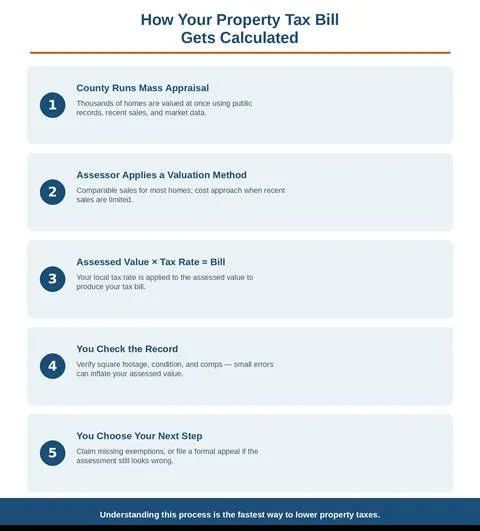
A common misconception is that someone visits every home each year to decide what it’s worth. In reality, that almost never happens. Instead, most counties use mass appraisal: standardized methods that value thousands of properties at once, using public records, recent sales, building characteristics, and local market data.
The goal isn’t to predict your home’s exact sale price tomorrow. It’s to value similar properties consistently under the same rules. These methods aren’t improvised. The International Association of Assessing Officers publishes the technical standards most U.S. assessors follow for mass appraisal.
Comparable Sales Approach
This is the method most homeowners recognize. The assessor compares your property with homes that recently sold nearby, often called comps, adjusting for differences in size, age, location, lot size, condition, and features. No two homes are exactly alike, so adjustments are common.
Cost Approach
When there aren’t enough comparable sales nearby, an assessor may estimate what it would cost to rebuild your home today, subtract depreciation for age and condition, then add land value. This approach shows up most often for newer or unique homes. Both approaches trace back to the same rulebook: the Uniform Standards of Professional Appraisal Practice maintained by The Appraisal Foundation, which covers mass appraisal alongside individual real estate appraisals. No matter the method, the goal is the same: a taxable value that’s fair and consistent with your local assessment rules.
Why Your Assessment Doesn’t Always Match Market Value
Market value is what a buyer would reasonably pay for your home today. Assessed value is what your county assigns for tax purposes, based on state laws and local assessment schedules. The two can be close, or months and even years apart, and that’s normal. Housing markets move quickly, but counties don’t always reassess every time prices shift. Some reassess annually, others every few years, and some states cap how much assessed value can rise each year, regardless of market swings.
The Lincoln Institute of Land Policy tracks these caps state by state. A gap between the two numbers isn’t itself a red flag. The real question is whether your assessment reflects your property’s actual characteristics and follows your county’s rules fairly.
Common Errors That Can Inflate Your Assessment
Assessments are built on data, and even small mistakes in your property’s record can raise your assessed value. Here’s what’s worth checking.
Incorrect Property Records
Your county assesses your home based on its records, so start there. Check your square footage, bedroom and bathroom count, lot size, and any garages or additional structures on file. If your home is listed at 2,700 square feet when it’s actually 2,400, your assessment may reflect a larger home than you own.
Outdated Records and Overlooked Conditions
Permits get issued for additions that were never finished. Old structures get demolished, but stay on the books. And because mass appraisal values thousands of homes at once, it isn’t built to catch every home’s current condition. The foundation issues, roof damage, or outdated systems may simply not be reflected in your number.
Poor Comparable Sales
Not every comp tells the full story. A recently renovated home with premium finishes isn’t a fair comparison for one with an original kitchen and roof. Location, lot characteristics, and condition all matter, so assessments work best when the comparison properties genuinely resemble your own.
Before You Appeal, Check This First
A quick address check can surface exemptions you may be missing, often faster than a formal appeal.
What to Do If Something Looks Wrong
Finding one issue doesn’t mean your assessment should change, but it’s worth a closer look. Start by verifying your property’s public record against reality, then compare your assessed value with similar homes nearby and confirm you’re claiming every exemption available to you.
Many homeowners jump straight to appealing their assessment, only to discover later that they qualified for an exemption they’d never claimed.
Understanding Your Assessment Is the First Step
You likely can’t control your local tax rate, but you can understand how your assessed value was determined. A higher bill doesn’t automatically mean you’re overpaying, but knowing how it was calculated puts you in a much stronger position to tell the difference. With HouseMaxxing, you can check what you may qualify for in about 30 seconds. Enter your address, and HouseMaxxing researches county and state exemption programs that may apply to your property. If nothing is found beyond the standard homestead exemption, you don’t pay. See What You Could Be Saving






 Ask ChatGPT
  Ask Claude
  Ask Perplexity